
For Groups Who Want to Feel the Start of Autumn in Okinawa by Street Kart: Clothing, What to Bring, and Coordinating Schedules, Step by Step
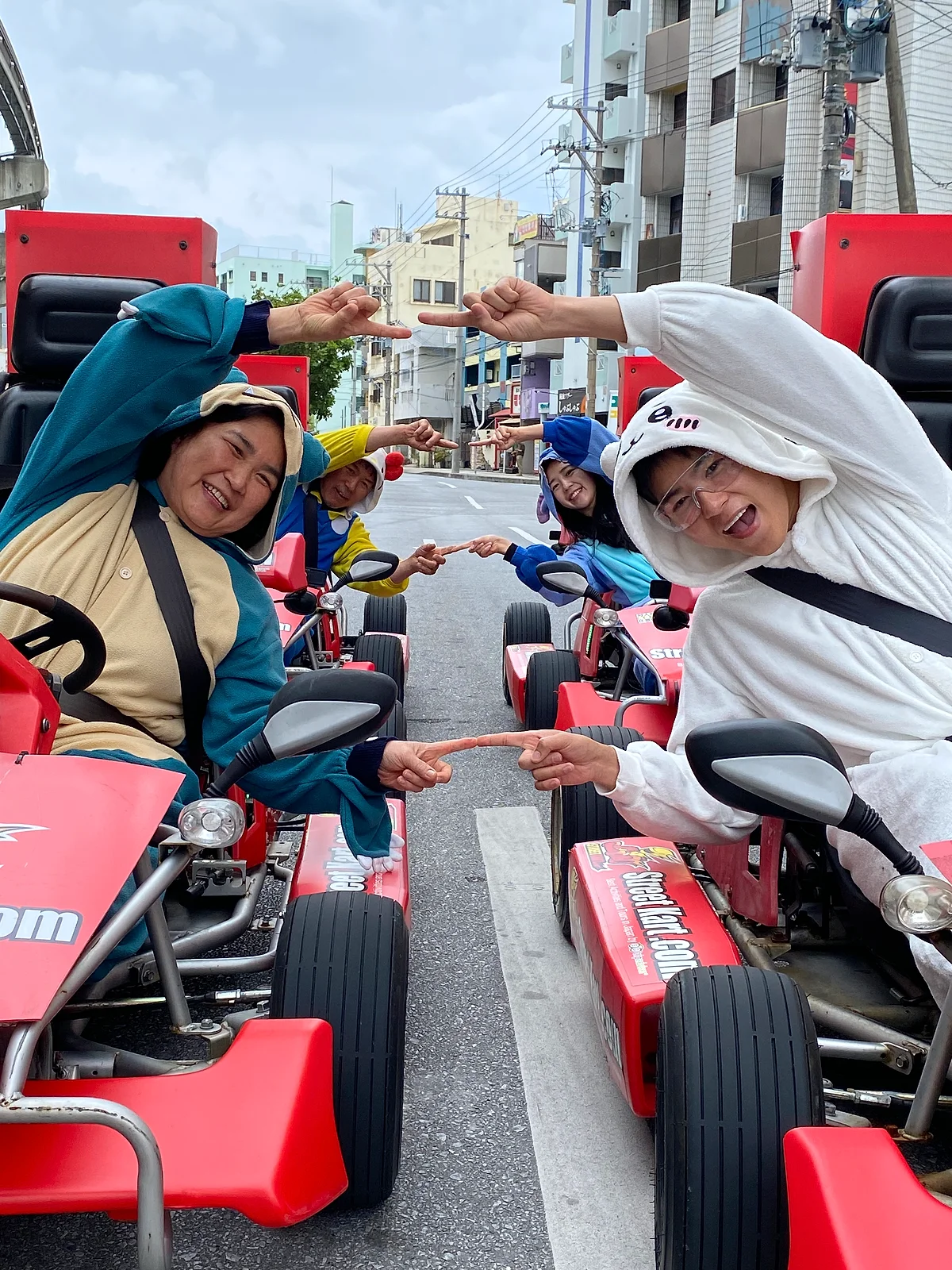
For Groups Who Want to Feel the Start of Autumn in Okinawa by Street Kart: Clothing, What to Bring, and Coordinating Schedules, Step by Step
The calendar already says autumn, yet the moment you step out of the airport in Naha, humid air clings to your arms. It has the slightly heavy feel of late summer. Plenty of people stop there and wonder, "Wait, where did autumn go?"
Autumn in Okinawa doesn't announce itself with changing leaves the way it does on Japan's main island. It arrives more quietly. The wind shifts direction a little. Some days the sky feels a notch higher than usual. The sea is the same sea, yet its color looks a little calmer. These small changes pile up, and by the time you notice, the season has already turned.
This article is for people visiting Okinawa in autumn for the first time. We'll go through how to read the air as the season changes, how to line up everyone's schedules, what to wear and bring, and how to spend the time before and after your Street Kart experience. The bigger the group, the more the planning decides how much fun everyone has. Let's take it one step at a time.
First, how to spot the "start of autumn" in Okinawa
Chinese has an expression, "秋老虎" (qiū lǎohǔ), for heat that hangs around stubbornly even though autumn has officially begun. Literally, it means "autumn tiger." In Okinawa, the start of autumn often looks exactly like that tiger: days spent lounging in the sun.
The start of autumn is still warm in Taiwan too, but visitors from Japan's main island tend to assume autumn means cool weather. They either dress too lightly or pile on too many layers. Okinawa has no switch that flips from one season to the next. Like waves rolling in and out, summer-like days alternate with slightly drier ones.
So what should you go by? The easiest sign is the wind. Okinawa has a name for the northerly wind that signals autumn's arrival: "Miinishi" (the new north wind). On days when it blows, the same temperature feels different on your skin. It's as if a layer of humidity has peeled away, and the air brushing your neck feels dry and light. When it starts blowing varies from year to year, so you can't plan around it. But if you notice during your trip that today's wind is different from yesterday's, you're already witnessing the start of autumn.
Another sign is the light. The sun that beat straight down all summer softens slightly, and some days building shadows stretch a little farther from your feet. The blue of the sea can shift from the white glare of midsummer to a deeper, calmer color. If you take photos, keep an eye on the length of those shadows.
The important thing is not to assume what the weather or temperature will be on a given day. Start following the forecast a few days before you leave and share it in your group chat. That alone makes choosing clothes on the day much easier.
Coordinate the group's schedule in this order
On big group trips, the arguments usually aren't about where to go but about the logistics. "Who's booking?" "What's the deal with their license?" "Where are we meeting?" If these back-and-forths drag on until the morning of, your time in Okinawa ends up remembered as exhausting. The shortcut is to decide an order and work through it from the top.
The first step is to propose dates as a range, not a single day. If you try to find one day when everyone is free, the more people there are, the harder it gets. Start by having each person say which weeks they can make, then look for the overlap. One thing worth knowing here: Street Kart bookings fill up fast on weekends. If your group can only go on a weekend, booking early leaves you more options. If some members can do weekdays, you have that many more combinations to work with.
The second step is checking the driving requirements. With Street Kart, you're behind the wheel yourself, so participants must be 18 or older and hold a valid driver's license for automobiles. Which licenses and documents are accepted depends on the country that issued your license and the type of license. Don't judge the whole group based on one person's situation. Each person should check their own on the official website. Only the original physical license is valid; digital licenses are not accepted. If you don't have the required documents on the day, you can't participate, and there are no refunds. On group trips this is the part people tend to brush off with "it'll probably be fine," but it's the one thing to get right for every member. Some documents take time to prepare, so get started as soon as you have candidate dates.
The third step is contacting them to book. Choose one person as the point of contact and have them handle all the inquiries; things go more smoothly that way. You can book via Facebook, LINE, or email (booking@streetkart.com). Put the license-issuing country, the number of drivers, your preferred date and time, and the store into a single message to cut down on back-and-forth.
One caution here. Street Kart is a guided tour, and a standard group is up to 6 drivers plus 1 guide. Large groups are listed as accommodated only at the Tokyo Bay store. If you want to join in Okinawa with more than 6 people, ask at the inquiry stage whether that group size works on that date. Keep a second plan ready in case you need to split up; it'll take some pressure off.
The fourth step is working out how you'll get there on the day. The store has no parking, so they recommend coming by public transportation. Group trips often rely on rental cars, but for this day, plan to leave the car behind. The store is about a 10-minute drive from Asahibashi Station on the Yui Rail, so it helps to decide ahead of time how you'll split into taxis from the station based on your group size. Booking a hotel near the store is another option. Nearby hotels include Hyatt Regency Naha Okinawa and Okinawa Kariyushi Urban Resort Naha. Check the official information for directions to the store.
The fifth step is deciding who will handle communication on the day. Tour guidance is generally in English. Guidance in Japanese or other languages depends on the staff that day and can't be guaranteed. If someone in your group is comfortable with English, think about the order you'll line up in and how you'll move so that person can stay within earshot of everyone. If any members are worried about English, it's a good idea to raise it when you inquire.
Once all this is settled, you're over the hardest part of the planning. All that's left is clothes, what to bring, and waiting for the Okinawan wind.
Clothing and what to bring for the changing season, and how to coordinate as a group
The turn of the season is the hardest time to choose what to wear. On top of that, every group has someone who runs cold and someone who runs hot. Not everyone has to dress the same. What matters is that each person has room to adjust for themselves. That's really all there is to it.
Start with a light top that dries quickly even if you sweat. Over that, bring one thin long-sleeve layer you can slip on easily and that isn't bulky when you take it off. It's your insurance for when the wind suddenly turns dry or the sun dips and you start to feel a little chilly. If it's hot, don't wear it. If you have it, you have the choice. Having that choice is what matters most when dressing for the changing season.
For bottoms, pick something easy to move in. The official guidance also recommends comfortable clothing and lists skirts and dresses as things to avoid. For footwear, closed-toe shoes such as sneakers are recommended. Avoid open-toe shoes like sandals, and avoid heels. We completely understand wanting to show up in flip-flops, but for this one day, switch to sneakers.
As for hats, it's safer to avoid styles that blow off easily in the wind. Putting on sunscreen before you leave makes things easier. It may be autumn, but there are still days when Okinawa's sun feels strong on your skin.
Pack as light as you can. Keep your phone and wallet in something you can stow away so they don't fall out or distract you while driving. Touching your phone while driving is dangerous, so save your photos for before you set off and after you finish. Things you absolutely must bring: your original driver's license, your passport for identification, and your booking confirmation email or booking number. The night before, have the whole group check in with each other: "Got everything?" It's unglamorous, but it's the most reliable thing you can do.
A word about the weather too. In light to moderate rain, tours run as scheduled and raincoats are provided. In heavy rain or typhoons, tours are canceled. Autumn skies in Okinawa can be hard to read, so if one person in the group knows how this works, nobody has to panic on the day. Check the official website for the latest policy.
What makes Street Kart special: what you see in Okinawa as the season turns
Now let's look at what the Street Kart experience is actually like.
First, a trained guide leads the way. Each course has a set route, and you drive following the guide in front of you. On group trips, the jobs of picking destinations and looking up directions tend to fall on the same few people. Just being able to follow the person ahead of you takes a weight off.
Next, there's the scenery on the Okinawa store's courses. Depending on the course, you'll drive around Naha Airport, Senaga Island, along the coast, and to Kokusai-dori. The sea seen from a low, open seat is completely different from the sea seen from an observation deck. The horizon is at eye level, and the smell of the ocean hits your face along with the wind. The engine hums low beside your ears. You take in the air of the changing season, which can't quite decide whether it's dry or humid, directly on your skin.
Third is Senaga Island. It's a small island south of Naha Airport, and Senaga Island Umikaji Terrace, with its white buildings stacked in tiers, looks like a Mediterranean town. Beyond it stretches an emerald-green sea, and you'll want to stand quietly for a while and watch the line where white meets green.
Fourth, around Naha Airport you can see planes taking off and landing up close. You look up from just above the ground at the place where you landed a few days earlier, now in the middle of your trip. The way the air trembles as a plane passes overhead is something you're likely to remember.
Fifth, it's close to the heart of Naha. Kokusai-dori is a 10-minute walk from the store, so it's easy to combine the experience with a walk around town before or after.
Sixth, the website is available in 22 languages.
Seventh is the track record. As of November 2023, across all stores, they have run more than 150,000 tours, served more than 1.34 million customers, and received more than 20,000 reviews, with an average rating of 4.9/5.0. There are 9 stores nationwide (7 in Tokyo, 1 in Osaka, 1 in Okinawa).
How to spend the time before and after
The time before and after the tour gives your group schedule some slack. Not everyone will necessarily make it to the meeting point on time. If you pick places where it doesn't matter if one or two people are late, everyone can relax a bit.
Before the experience, how about the Makishi Public Market on Kokusai-dori? It's a 10-minute walk from the store, and known as "Okinawa's kitchen," it's packed with Okinawan ingredients. You can buy ingredients at the market and have them cooked for you on the second floor, so a group can share small portions of lots of dishes. A lively lunch of everyone picking from big plates is just the right fuel before you drive.
If you'd rather take it slower, head to Yachimun Street (Tsuboya), a 15-minute walk from the store. The street is lined with shops selling yachimun, Okinawa's traditional pottery, along with cafés. "壺屋" is read "Tsuboya." The character "壺" is the same as in Traditional Chinese, so visitors from Taiwan will probably find themselves reading the signs without even trying. Watching the soft autumn light slide across the glazes, you may feel time start to move a little differently.
After your drive, go souvenir hunting on Kokusai-dori. You'll find Okashigoten's purple sweet potato tarts and Blue Seal ice cream. Then it's time for photos. Even after you step out of the kart, you can still feel the wind on your cheeks. Take photos and videos as a group before that feeling fades. Combining hashtags like "#沖繩" and "#沖繩旅行" on Xiaohongshu, or "#沖縄" and "#okinawatrip" on Instagram, makes it easier to look back on later as a record of your trip.
If anyone wants to see the sea, Naminoue Beach is a 20-minute walk from the store. Spending the evening idly watching the sky slowly change color with your group isn't a bad way to end a day at the start of autumn.
For anyone who wants to visit Shuri Castle, it's about a 20-minute drive from the store. It's still being rebuilt after the 2019 fire, but you can see the Shureimon Gate and the exhibits. If you fit it in on the same day as the experience, give yourself plenty of travel time.
With a large group, it also works well to split the time after the experience into "everyone together" and "free time." Some people want to buy souvenirs, some want to see the sea, some want to rest at a café. It's natural for people to want different things, so just set a meeting place and time and let everyone do their own thing. If you all get back together for dinner at the end, everyone can share stories from their own day.
Common questions from first-timers
"Can we get out of the kart partway through and stop at places that catch our eye?" The tour follows a set route led by the guide. Check the official website for details on how things run while driving. To be safe, plan to visit places you want to take your time at before or after the tour.
"How much does it cost?" This article doesn't list prices. They vary by season and time of day, so check the official website (kart.st) for current pricing.
Bringing the group's plans together as autumn begins
The start of autumn in Okinawa doesn't arrive suddenly one morning. Days when the wind feels a little drier and the light a little softer go back and forth with the last of summer, gradually becoming more frequent. If you want to feel that change with your whole body, driving in a low seat through the seaside wind on a Street Kart is one good answer.
You can book via Facebook, LINE, or email (booking@streetkart.com). Tour details and what to prepare for the day are on the Street Kart official website. Start by sending one line to your group chat: "Anyone free this week?" While you wait for replies, try opening your window a little. The wind may already be starting to change direction.
This article was originally written in Japanese and translated using AI. Some expressions may read unnaturally, and we appreciate your understanding. For the most accurate and up-to-date information, please refer to the official site at kart.st.
Street Kart is not affiliated with Nintendo or the Mario Kart series in any way. We do not provide costumes of Nintendo characters, and such costumes may not be worn during tours even if brought by participants.