
The Bustle by the Station and the Quiet of the Back Alleys in Naha, Okinawa: How a Street Kart Ride Changes Your Friend Group's Reactions
The Bustle by the Station and the Quiet of the Back Alleys in Naha, Okinawa: How a Street Kart Ride Changes Your Friend Group's Reactions
The Yui Rail doors slide open, and the humid air sticks to your cheeks. Almost at the same moment, the group chat starts buzzing. "Where are we meeting?" "I'm already past the ticket gates." "Sorry, I'm at the convenience store." When five or six of you come to Okinawa together, the first few minutes usually go something like this.
Later, after a street kart ride, the same group walks into the back alleys of Tsuboya, and for some reason everyone starts talking more quietly. Naha has the noise around its stations, and it also has the quiet of the alleys just one street over. This article follows your friends' reactions to show how different those two moods feel. Along the way, it also covers how to coordinate plans when you're traveling in a large group.
In the station-side crowds, the group "splits up" first
As you walk from the Yui Rail station toward Kokusai-dori, the sound around you gets noticeably thicker. Shop staff call out to passersby, music drifts from the back of restaurants, and applause rises from a street performance that's started somewhere. Kokusai-dori is Naha's main tourist street, about 1.6 km long, and it's nicknamed the "Miracle Mile." Souvenir shops, restaurants, and gift shops line the sidewalk with no gaps between them.
This is where the group almost always splits up.
Your souvenir-hunter friend stops in front of the purple sweet potato tarts at Okashigoten. They can't take their eyes off the display case full of purple cross-sections. Your sweets-lover friend spots the Blue Seal sign and is already heading for the line. Your photographer friend keeps their phone pointed at the crowd around the performance, and before you know it they're three meters behind. Nobody is doing anything wrong. Kokusai-dori is a street that pulls people off, one at a time, to different storefronts.
If you're visiting from Taiwan, the crowds might remind you of a night market, and you might think, "This is nothing." But it feels a little different from the way you move through a night market, weaving between rows of food stalls. On Kokusai-dori, people get drawn into the shops along the sidewalk one by one, so the flow of the crowd keeps turning sideways. Once you notice that, the same crowd starts to look different.
That said, how crowded it gets depends a lot on the day of the week, the season, and the weather. Don't assume "Kokusai-dori is always like this." Walk it ready to see whatever side the street shows you that day.
How does Kokusai-dori look different from a kart than on foot?
You drive down the same street you were just walking, but now you're holding a steering wheel. That's what this article is really about.
At Street Kart's Okinawa (Naha) location, a guide leads each tour along a course set by that location. You don't get to pick your own roads. The places listed on the Okinawa routes are Kokusai-dori, Senaga Island, and the area around Naha Airport. Which spots you pass depends on the course, so check the official website for that day's route.
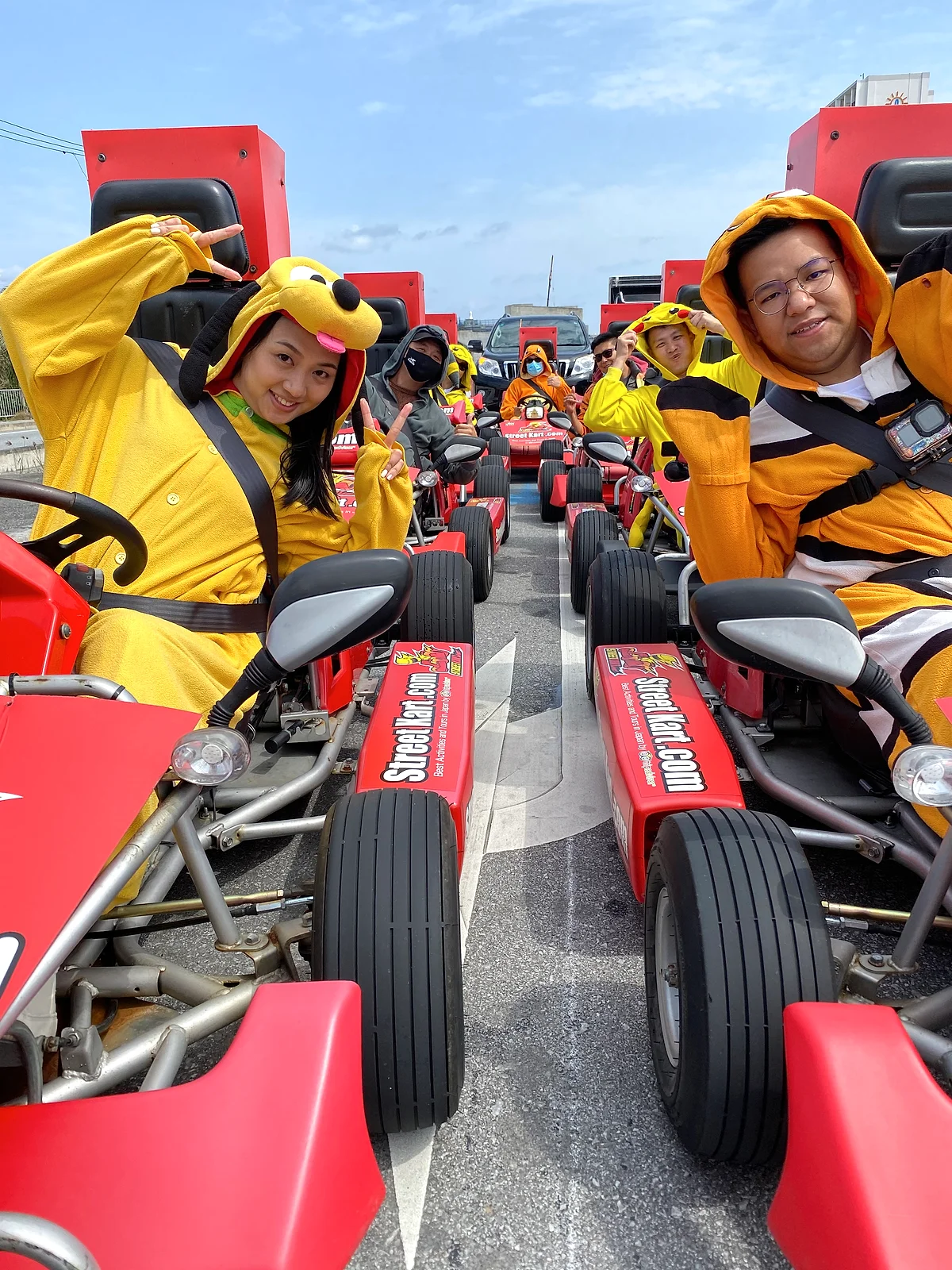
Once you put on your helmet and pull away with goggles on, the city reaches you differently than it did on foot. The wind hits you head-on, and the shop calls and music come close and then slip away behind you. Things that were just background while you were walking come into view one by one: the colors of the signs, the seams of the storefront shutters, the edges of the curbs. When you travel as a group, one person often ends up navigating and misses the scenery. With the guide's back in front of me, I could keep my attention on my own steering wheel and on the city passing by. Meanwhile, that friend who wouldn't budge from the purple sweet potato tarts is looking at the same street from a completely different angle. Driving behind them and watching their back, I couldn't help smiling a little.
At Senaga Island, the view suddenly opens up overhead. There's the emerald-green sea and Senagajima Umikaji Terrace with its rows of white buildings. Around Naha Airport, you may see planes taking off and landing. When a plane crosses overhead with that low rumble, your plane-loving friend will probably shout right about here. But the color of the sea and how clear the sky looks depend on the season and the weather. I think it's best to go in simply ready to enjoy whatever colors that particular day gives you.
One important thing: don't touch your phone while driving. Save your photos for when you walk around before or after the tour. While you're in the kart, keep your eyes on the guide's signals and the vehicle in front of you. It's the most basic rule for making sure the whole group finishes the ride happily.
Tours are generally guided in English on the day. Whether guidance in Japanese or other languages is available depends on the staff that day, so it isn't guaranteed. If someone in your group isn't confident about understanding English, try contacting the shop in advance.
One street over, your friends' voices get quieter
Once the tour ends, it's time to explore on foot. Near the shop, there are places where the atmosphere feels completely different from Kokusai-dori.
About a 15-minute walk from the shop is Yachimun-dori (Tsuboya). "Yachimun" is the Okinawan word for pottery, and this is a pottery district lined with ceramics shops and cafés. After Kokusai-dori, your ears feel like they can pick up even the sound of your sandals scraping the stone pavement. When you pick up a piece from a shelf, the surface is cool, and your fingertips can feel the slight unevenness of the glaze.
A note on the characters: the "壺" in "壺屋" (Tsuboya) looks exactly the same in Traditional Chinese. In Simplified Chinese it's written "壶." So when you text the place name to friends who read Chinese, typing it in Traditional characters gets the name across as is. Pottery is "陶瓷" in Chinese. There's usually at least one friend who looks at the pottery and murmurs "這個好可愛" ("This is so cute").
Within a 10-minute walk of the shop, you'll also find Ichiba-hondori and the Makishi Public Market. The Makishi Public Market is known as "Okinawa's kitchen," and you can buy ingredients at the market and have them cooked for you on the second floor. Under the arcade, it isn't as noisy as Kokusai-dori. Instead, you hear the short exchanges at the stalls and the dry rustle of plastic bags right next to you.
It's all Naha, but turn a single corner and the city's temperature changes. The group's reactions split the most during this time in the alleys.
Your photographer friend suddenly goes quiet in the alleys
On Kokusai-dori, your photographer friend kept shooting the crowds, but on Yachimun-dori they suddenly go silent. They keep the focus on a piece of pottery on a shelf and don't move for a while. They're waiting for a bit of outside light to land where the glaze has pooled.
If you're taking photos, try shooting the pottery shelves from a slightly low angle, looking up, to add depth. Some of the alleys are narrow, so when you stop to take a picture, pick a spot where you won't block people walking by. If you want to photograph items in a shop, it's good manners to ask first.
For editing, if you want to keep the colors of the pottery, my own preference is to lower the saturation just slightly in Lightroom and pull down the highlights. The softness of the air comes less from a strong filter and more from softening the harsh edges of the light. For hashtags, along with #那覇 #壺屋 #やちむん, add the Chinese tags #沖繩自由行 #沖繩陶器 so your post also reaches your Chinese-speaking friends.
Your foodie friend gets serious at the market
The moment you reach the Makishi Public Market, your foodie friend gets a completely different look in their eyes. You pick out ingredients and have them cooked upstairs on the second floor. Taiwan also has plenty of market stalls where you can eat on the spot. Even so, choosing your own ingredients and having them cooked on the floor above should feel a little fresh. Through the steam, you'll hear "好吃" ("delicious") from tables all around.
If many people in your group love fish, Tomari Iyumachi (a fish market with eateries), about a 20-minute walk from the shop, is another option. But not everyone will want to eat the same amount. Appetites vary from person to person, so before choosing a place, ask the group once, "How hungry is everyone right now?" That saves you arguments later.
And your friend who likes the bustle will say, about ten minutes into the alleys, "Shouldn't we go back to Kokusai-dori?" That's completely fine. In fact, that's the moment to split up. This way of thinking leads right into the planning section below.
Four ways to think about planning for a large group
On a big group trip, the hard part is often coordinating everyone's plans, not the activities themselves. Here are some ways to think about making it work. Things like how many people can join depend on the tour's situation, so contact the shop in advance if you want to check.
First, lock in your kart time slot before anything else. Build the day around the thing with a fixed reservation time, and fit everything else before and after it. That gives the day a clear shape. Weekends tend to book up quickly, so if your group is going on a weekend, it's best to act early. Reservations are accepted via Facebook, LINE, and email, and the contact details are on the official website. The official website is available in 22 languages. Before booking, I'd send everyone the link to the official site and ask them to read through it once in whatever language is easiest for them.
For details on how tours are organized, such as whether you'll be grouped with other participants, check the official website. For costs, it's smoother to set things up ahead of time in a bill-splitting app. Prices vary by season and time of day, so check the official website (kart.st) for the latest rates.
Second, have each member check their own driver's license. The riskiest thing is for the organizer to decide for everyone that "it'll probably be fine." What you need depends on your nationality and the type of license you hold. You need your original physical license; digital licenses are not accepted. Each person should read the driver's license information on the official website and confirm their own situation before you move on to booking. See the official website for details.
Third, set your meeting point somewhere before the shop, not in front of it. The shop has no parking, so take public transportation to get there. As mentioned in the Kokusai-dori section, the group tends to split up as soon as you arrive at the station. It's safer to gather everyone at an easy-to-find spot first and then walk to the shop together. Hyatt Regency Naha Okinawa is also near the shop (a 5-minute walk). If anyone in the group is staying nearby, that can work as a landmark.
Fourth, split up after the tour and meet up again later. If everyone tries to visit the same places together, someone always ends up bored. The alley fans head to Yachimun-dori, the market fans go to the Makishi Public Market, and the people who like the bustle go back to Kokusai-dori. Just decide on a place to regroup, and share your locations in the group chat so nobody gets lost.
When you spend time apart, you bring more stories back to the dinner table. "So the grandma at the pottery shop said..." "What I ordered at the market was three times bigger than I expected." You were all in the same Naha, yet everyone is talking about a slightly different city. Those differences are the best thing to go with your drinks on a travel night.
What makes Street Kart appealing
So far this article has mostly been about how to explore Naha. From here, let's look at the features of Street Kart itself from the point of view of a group taking part.
First, the track record. As of November 2023, across all locations, Street Kart had run more than 150,000 tours, served more than 1.34 million customers, and received more than 20,000 reviews, with an average rating of 4.9/5.0. It had more than 250 vehicles in total. All of these figures are as of November 2023.
Next, the locations. Street Kart has 9 locations across Japan (7 in Tokyo, 1 in Osaka, 1 in Okinawa). If your group plans to travel around Japan beyond Okinawa, you also have the option of driving in another city.
After seeing both the bustle and the quiet, what does the group talk about on the way home?
You split up by the station, took in the same scenery from the karts, and then scattered in different directions again in the alleys. Looking back on your day in Naha, you'll notice how many times the distance between everyone in the group stretched and shrank.
The photographer who went quiet in the alleys is often the one talking the most on the Yui Rail back. And the friend who kept wanting to go back to Kokusai-dori is sometimes the one holding the small cup they bought in Tsuboya on their lap, wrapped up more carefully than anything else. Outside the window, the city you drove through earlier slowly sinks into evening colors. I think it's because you spent the day walking through both the bustle and the quiet that those small differences in reactions stay with you.
Start by listing the days everyone is free, and lock in your kart slot first. If you're going on a weekend, book early. You can check the tour details and reservation contacts on the Street Kart official website.
This article was originally written in Japanese and translated using AI. Some expressions may read unnaturally, and we appreciate your understanding. For the most accurate and up-to-date information, please refer to the official site at kart.st.
Street Kart is not affiliated with Nintendo or the Mario Kart series in any way. We do not provide costumes of Nintendo characters, and such costumes may not be worn during tours even if brought by participants.